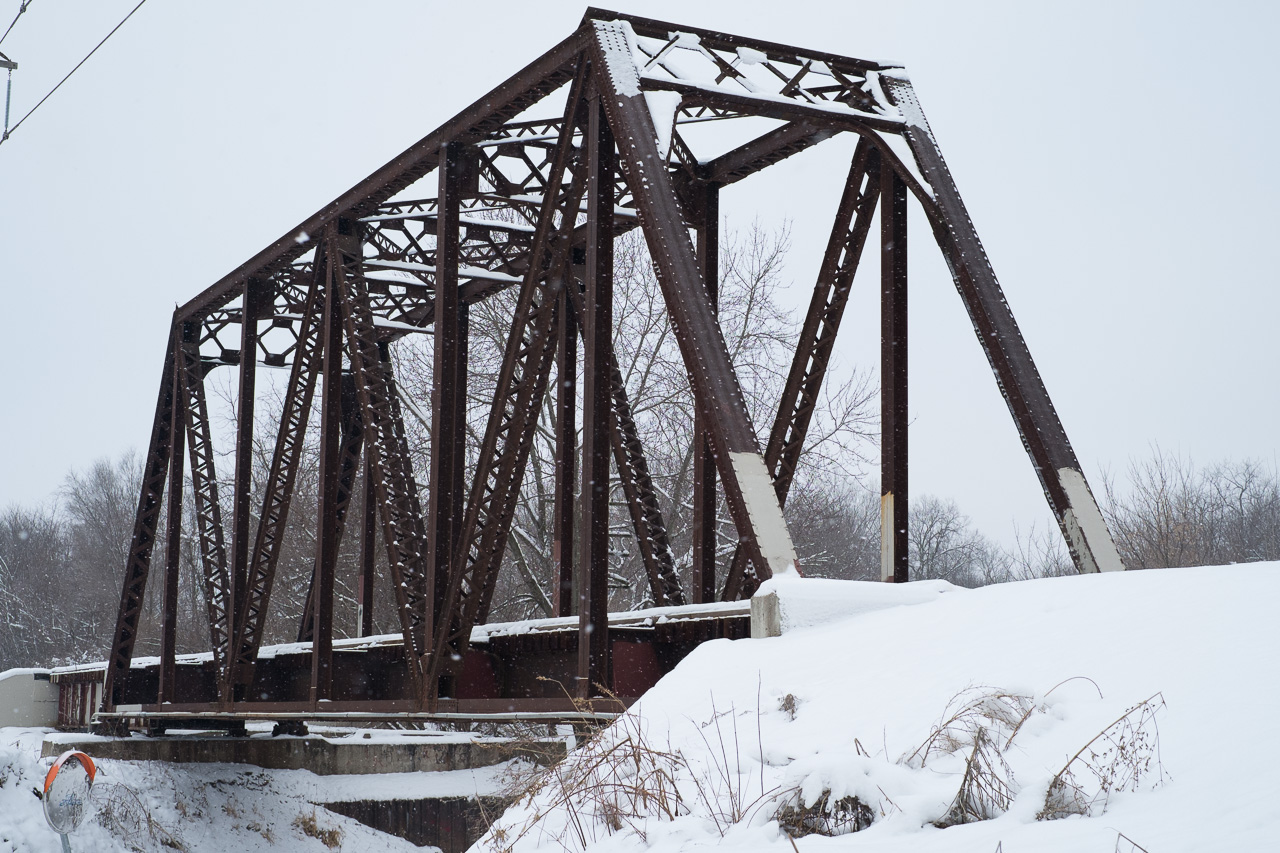
The cycling season is off to a rather slow start for me this year. Although we are now halfway through April, spring has not had the decency to stick around and be friendly. Almost weekly snowstorms are mixed with warm days, cool days, and windy days, and they don’t always align with my free time.
I think this is the slowest and coldest start to spring in the 6 years I’ve lived in Denver. And it’s put a real damper on my riding.
I’m no fair-weather-only rider, but I vastly prefer it. And out here that usually works.
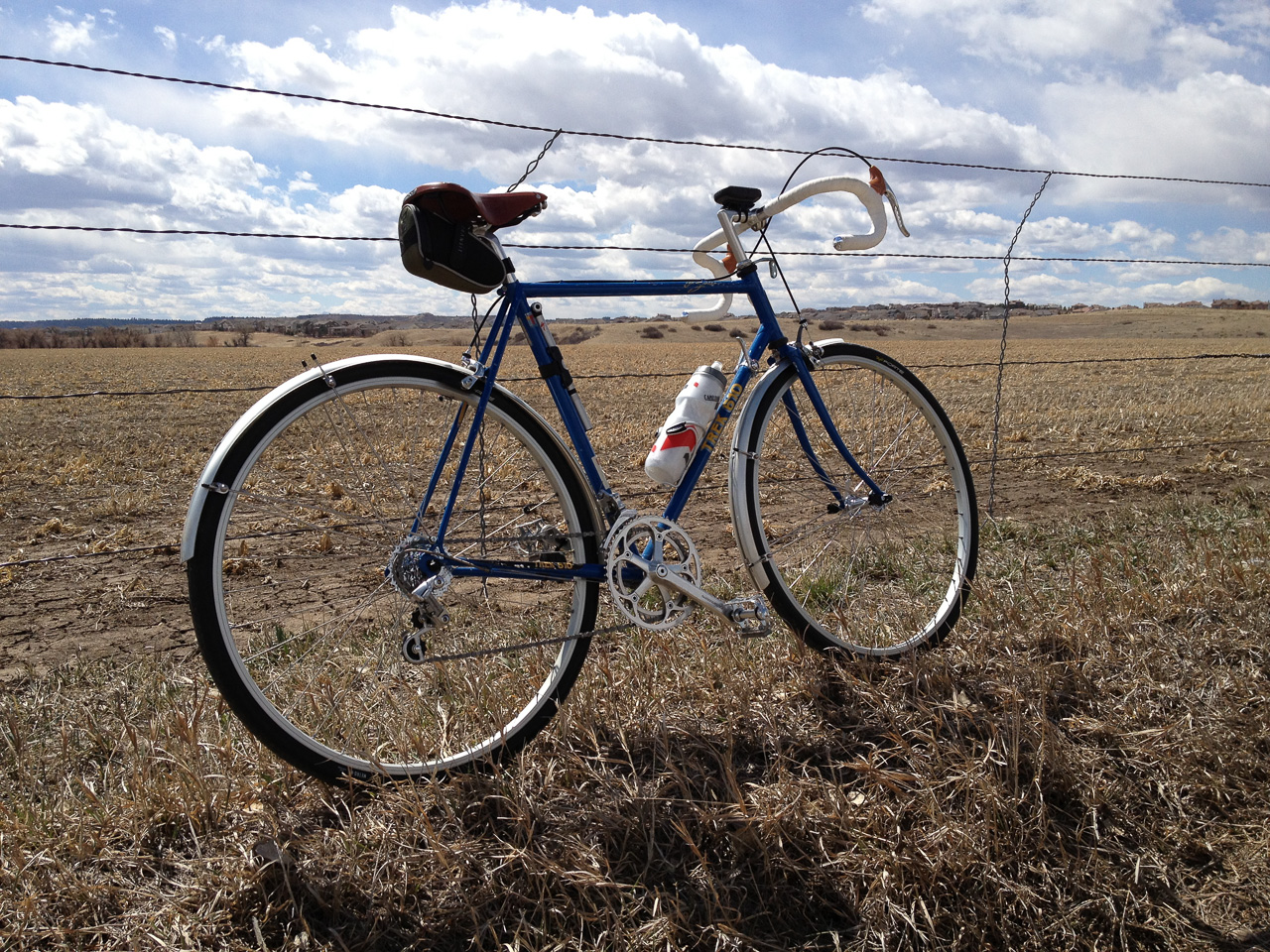
And before the season started I even spent time and money getting my road bike prepped for a new season.
My original rear wheel, with its thin rim and bad French hub, finally gave in near the end of 2012. It was impossible to keep true, pulled a spoke nipple, and had an alarming amount of play in the hub that led to numerous phantom shifts. It was time to finally do something.
So before the weather was really amenable to regular riding, I called up the owner of a shop in the Twin Cities about getting a new set of wheels. I’d looked around locally, but most of the wheel builders I found in Denver seemed to focus pretty strongly on the racing market. I wanted strong, inexpensive, well built wheels instead. I had no interest in fancy and not much interest in lightweight.
It didn’t hurt that the shop owner went to grad school with Ben. I like the connection over someone wholly unknown. Jim, the shop owner, helped me choose rims and hubs, and put together a configuration that would work with my old frame without changing any other components.
And yes, the rims are 29er rims. Measurement shows they’ll be good for tires from about 28mm to 45mm. I usually ride 32mm or larger tires, so this seemed like a good choice.
When the wheels arrived I got everything set up and picked up a cheap set of 700×35 tires and managed one break in ride. Then the weather turned bad, I traveled a lot, and got sick. It wasn’t until late March that I could even get a real ride in on the new wheels. They’re lovely, but after that one big ride and a few short rides I got stuck again.
More travel, another cold, and several more snowstorms. Snow this week too. It’s getting a little out of hand. Less than a hundred miles this year.
I’m hopeful that in another week or two things will settle out and I can get some real riding in. I need it and I really want to get a lot of miles in the new wheels. Make them mine, if that makes any sense.
Spring is here, and warm weather is becoming normal now despite the occasional cold wet day. My last brew, an IPA based on Bell’s Two Hearted, is a good style for warm weather. But I also love wheat beers and strong effervescent ales in warm weather.
One of my favorite strong bubbly ales is the American farmhouse style Tank 7 from Boulevard. It’s certainly Belgian in inspiration, similar to a saison or strong golden, but the hop choices are more American. It has great drinkability and high alcohol content, which is a wonderful combination on a warm summer evening.
This style of beer is my next brew, which I’ll be doing tomorrow, April 6.
Unlike the Two Hearted, I am not trying to clone Tank 7. I wouldn’t mind coming close, but I’m trying more to brew something of my own based on the style than match the actual beer’s profile.
I certainly researched people’s recipes for the beer, including a third-hand statement on the mash and hops Boulevard uses, supposedly relayed by head brewer Steven Pauwels himself.
I don’t trust any of this specifically, but in aggregate I think I have a recipe that will be style appropriate.
The tricky parts are my inexperience with using corn as an adjunct, and the weird farmhouse ale yeast I plan to use, White Labs 670. It’s weird because it has a mix of normal Saccharomyces yeast with Brettanomyces, and I am finding mixed things on how long a beer needs to condition before some of the Brett funkiness appears in the beer.
So I’m going to guess at a schedule, and assume this beer will be ready in mid June.
The recipe:
This recipe is tuned for my simple brewing system where I can get a 75% mash efficiency consistently. I can’t easily do multiple temperature rests, so I’m going with a single infusion mash at 149F (compared to my more usual 152F). The lower temperature and addition of corn should get a more fermentable sugar mix that will allow for a lower gravity, dryer finish.
As I wrote a couple of weeks ago, I tried to brew a decent clone of Bell’s Two Hearted Ale, one of my favorite beers, during my last brew session. Now that the beer has carbonated, and I have gotten past my awful spring cold, I was able to compare the real thing to my homebrew side by side.
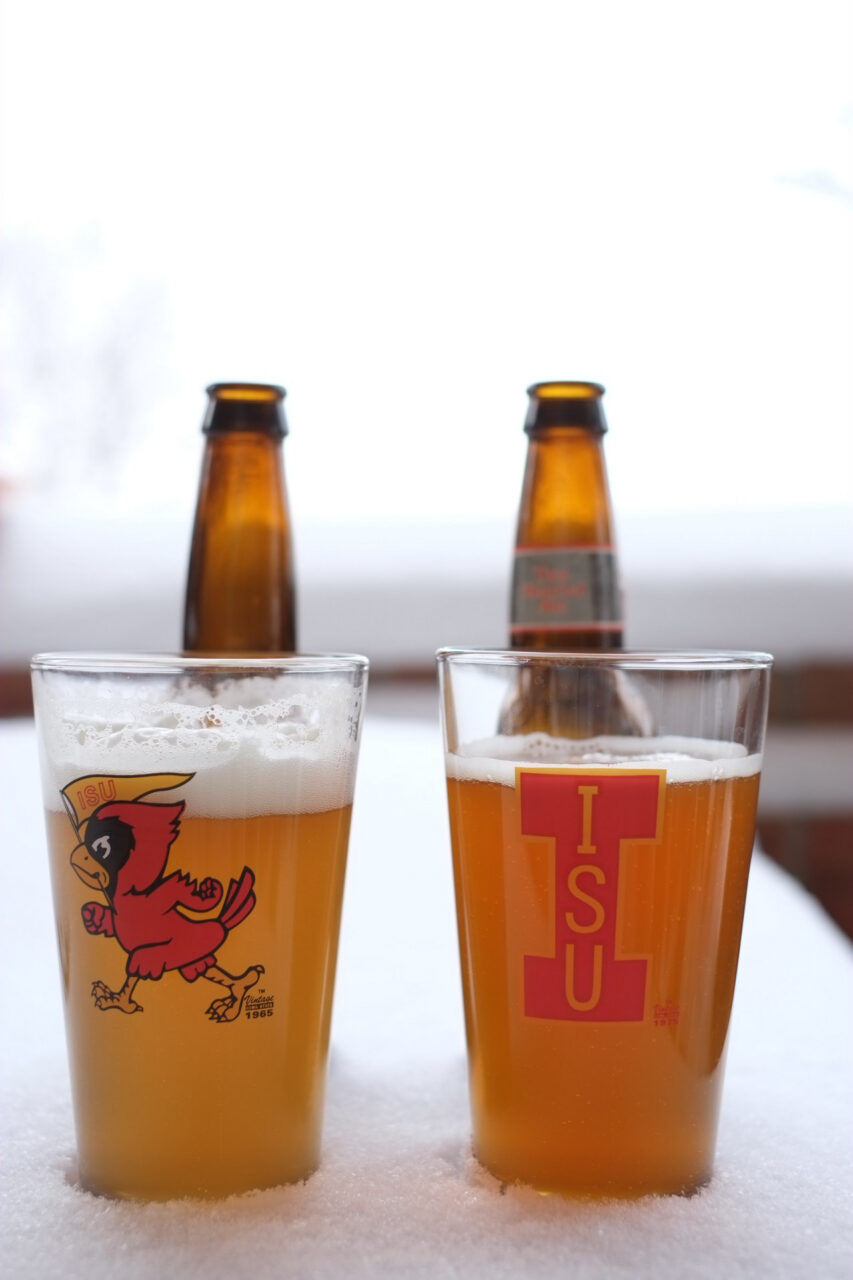
I refrigerated one bottle of each beer, poured them into two similar glasses, and placed them side by side. My homebrew is on the left, in the 1965 ISU glass. Bell’s Two Hearted is on the right, in the 1975 ISU glass.
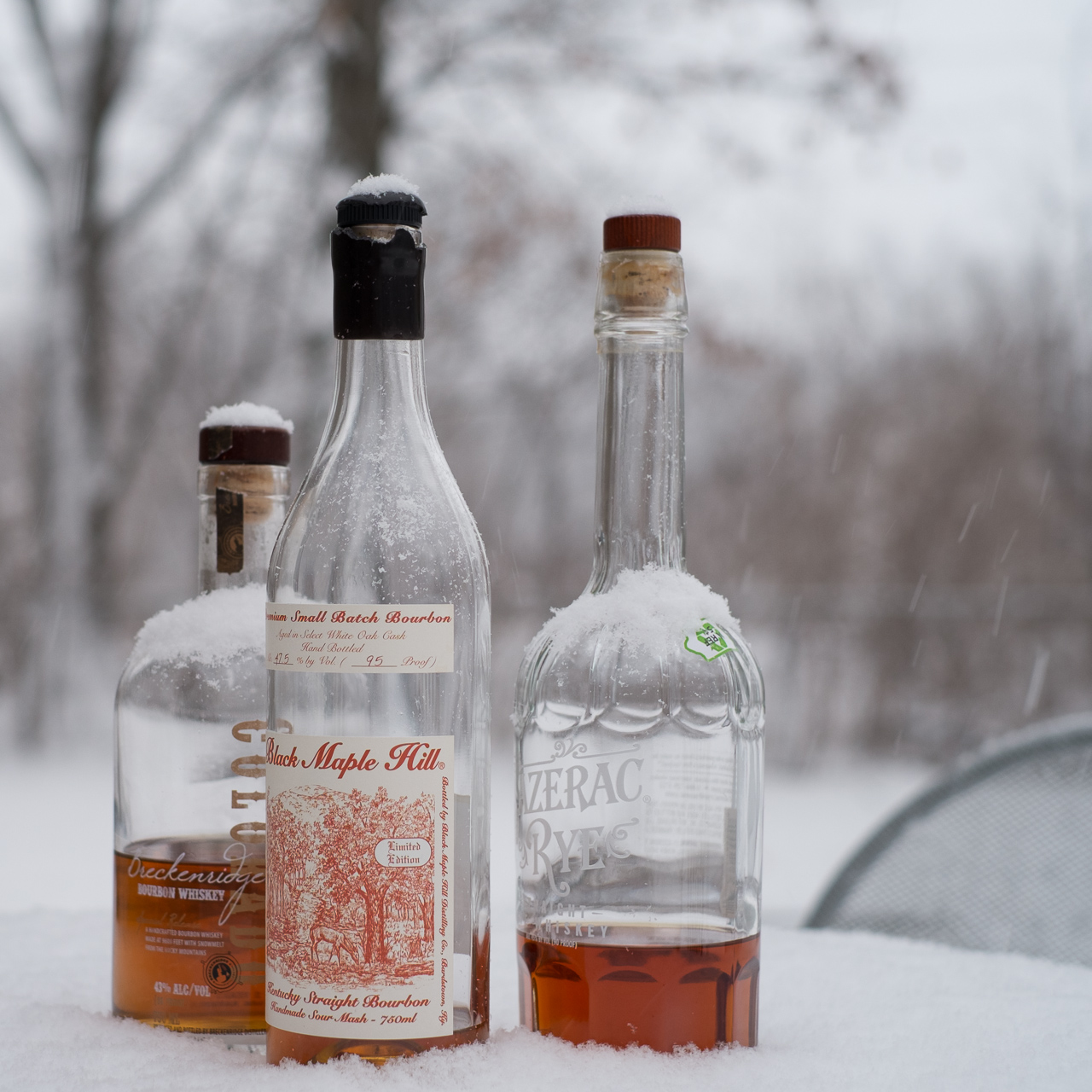
As the photo shows, we had a big snowstorm in late March. It also shows that my homebrew is a slightly lighter color than the Bell’s brew. This could be that Bell’s uses a longer boil, but it is more likely that the real thing has a higher percentage of the darker malts. It could also be that the Colorado malt I used is paler than Bell’s pale malt. Whatever the actual cause, the color isn’t quite there.
The photo also shows that my homebrew has a larger head, though the color and size of the bubbles are very similar. This could be because I carbonated to a slightly higher level, or it could be another factor affecting head retention. It’s hard to say.
The homebrew had a more noticeable hop aroma. A really nice bright floral note when I stuck my nose in the glass. The Bell’s beer had much less of a up front hop aroma, but it could be the time it spent since bottling (bright hop notes fade over time).
The Bell’s brew had a much more up front hop flavor on the tongue though. I don’t think it was actually much more bitter, as the perceived malt levels of both beers were pretty similar, but I think that they may have used more hops in the later parts of the boil. Mine had a pleasant hop flavor, but nowhere near as assertive as Bell’s. I think moving the hop additions around a bit so that the IBUs stay similar but more hops are added in the last 15 – 20 minutes of the boil would help.
In the end, I made a very tasty well balanced American IPA. But I didn’t quite match my target. I might try this again in the future with slight changes to get the color and hops closer to the real thing. Things to try include more caramel malt, whole hops rather than pellet hops, and hop schedule changes.
And even though I didn’t match the target beer, I’m still going to thoroughly enjoy drinking what I did make.
My latest brew is an attempt to clone Bell’s Two Hearted Ale. Bell’s is one of my favorite breweries, but I can’t buy their beer out here in Colorado. Instead I buy a bunch every time I head back to Iowa, but it doesn’t last forever.
Of Bell’s beers, their Two Hearted Ale, an American style IPA, is one of my very favorites. It is hoppy without being unbalanced, and the use of only Centennial hops works far better than I would have expected.
Since the six pack I bought during my Christmas holiday won’t last forever, I decided to try to brew a clone instead. The clone is based on a recipe posted to a popular homebrewing forum, with only minor changes to the malt bill and adjustments to the hop additions because of the higher alpha acids in the batch I used. I took this brew as a chance to try the Colorado two-row pale malt I’ve been eyeing for a while.
I actually did this brew back in January, but I only bottled it a week ago, and it’s not quite ready to drink yet. I’ll probably follow this up with a side by side comparison with actual Two Hearted Ale when it is.
The recipe (60 minute boil):
I know my simple brewing system well enough to target a 75% mash efficiency, which I usually hit within a couple of points. It was therefore easy use the grain bill from the forum recipe and have confidence I would hit the target. It took almost a half dozen brews to have that confidence in my skill and equipment; previously I had brews both above my target OG and well below. The beer was still good, but I wasn’t hitting the numbers I wanted. I have a much better chance now.
Malt
10.0 lbs Colorado Two-row Pale Malt
2.0 lbs Briess Vienna Malt
0.5 lbs Briess Carapils
0.5 lbs Briess Crystal 20L
Hops
0.8 oz Centennial 11.6%, 60 min
0.8 oz Centennial 11.6%, 15 min
1.0 oz Centennial 11.6%, 5 min
1.0 oz Centennial 11.6%, 1 min
1.0 oz Centennial 11.6%, 7 day dry hop
Yeast
Yeast harvested from a bottle of Bell’s two hearted and cultivated in a starter
The forums think that Wyeast 1272 is a close match to the Bell’s yeast
Mash
Infusion: 19.5 quarts at 170F
Sparge: 17.5 quarts at 170F
Harvesting the yeast
The one new thing I had to do for this brew was harvest the dregs of a bottle of Bell’s Two Hearted Ale and cultivate the small amount of yeast left in the bottom of the bottle into enough clean yeast to brew a 5 gallon batch of beer.
I had to build up that small amount of yeast by feeding it wort and oxygen so it could multiply. I started by preparing wort for a normal yeast starter. I prepared some santizer and sanitized the lip and inside the neck of the bottle after opening it. I carefully poured the beer into a pint glass and reserved it, leaving all the yeast in the bottle at the bottom, which was then pitched into the starter while I drank my glass of beer.
Further reading showed that I may have wanted to start the first round of cultivation with something more dilute, but the yeast seemed to take to it well.
After a couple of days on the stir plate I had a decent amount of yeast. I refrigerated it and then decanted the beer off the top of the yeast layer. I pitched a new batch of starter wort on top of the yeast and put it back on the stir plate for a couple more days. I did this one last time, and at the end of that had about as much yeast slurry as I do for a normal batch of beer.
As noted above, the internet is pretty sure that Wyeast 1272 would give essentially the same results, but it was fun to grow the yeast from a single bottle into something I could use for a whole batch of beer, and to know I was using the same yeast that Bell’s did (assuming it didn’t mutate).
The stats and style notes
Per the BJCP guidelines this beer is an American-style IPA. I have a few notes on the Bell’s beer that indicates it is about 7% ABV with a starting gravity of about 1.064. This is the best I had to go on though.
American IPA
American IPA
Homebrew
Bell’s Estimate
BJCP Reference
Calories (12 oz)
210
N/A
N/A
IBUs (bitterness)
59
55
40 — 70
Color (SRM)
6.0 (light amber)
??
6 — 15
ABV
6.8%
7.0%
5.5% — 7.5%
OG
1.064
1.064
1.056 — 1.075
FG
1.012
1.010
1.010 — 1.018
So I’m near 7% ABV, and within all the style targets for an American IPA. The notes I have on actual Two Hearted Ale are similar.
Early taste checks
As is normal for my process I taste samples of the beer as it moves along the fermentation and conditioning processes. This beer has by far the strongest hop aroma of anything I have brewed. I am not sure it is the most bitter, but the large late hop additions and dry hopping mean there is a big forward hop smell and flavor. The color is about right too.
When the beer has fully carbonated I’ll refrigerate a bottle of Bell’s Two Hearted and a bottle of my clone, and do a side-by-side comparison. It will not be a double blind taste test, just a comparison of color, clarity, head, aroma, taste, feel, and so on. I’m curious to know how close I got.
Even if it isn’t perfect, I think this is going to be a good batch. And my notes show it is my first IPA.
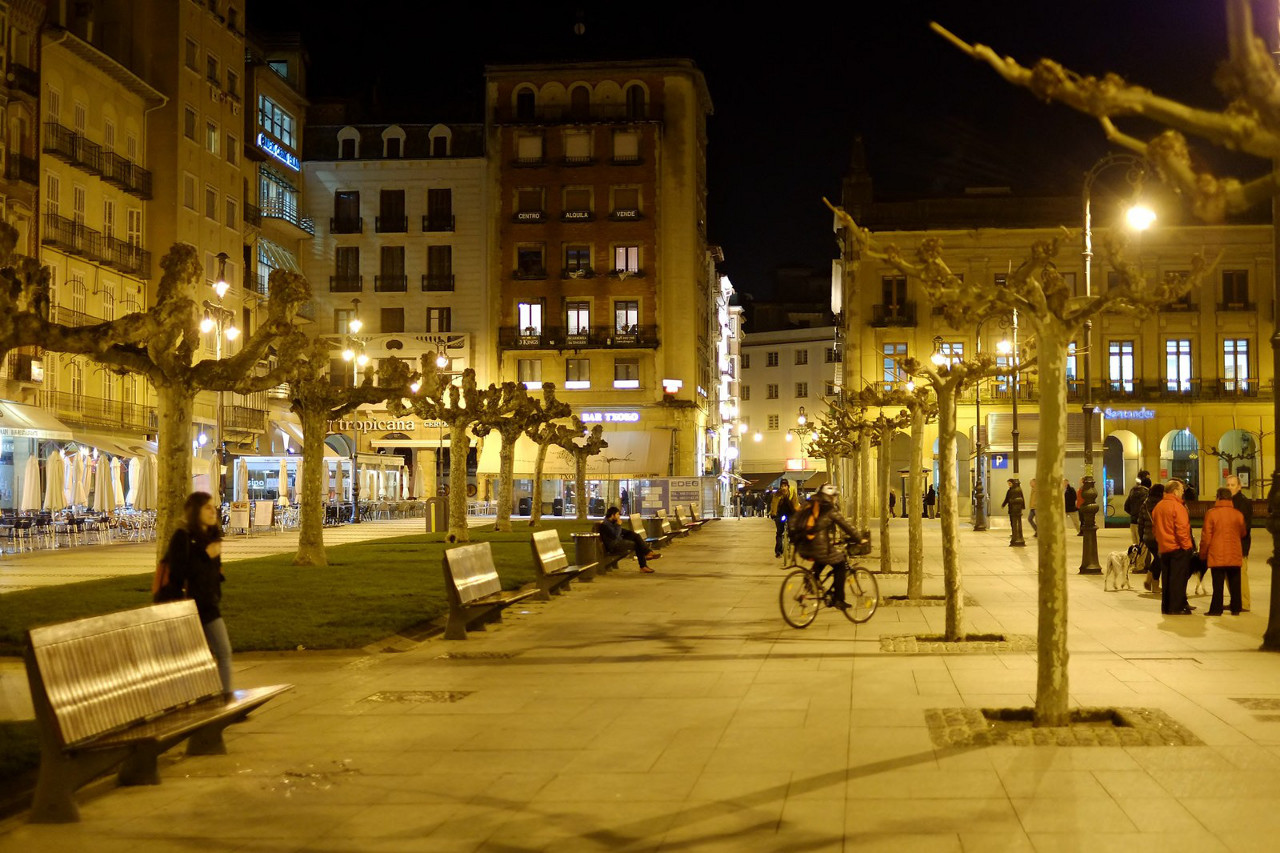
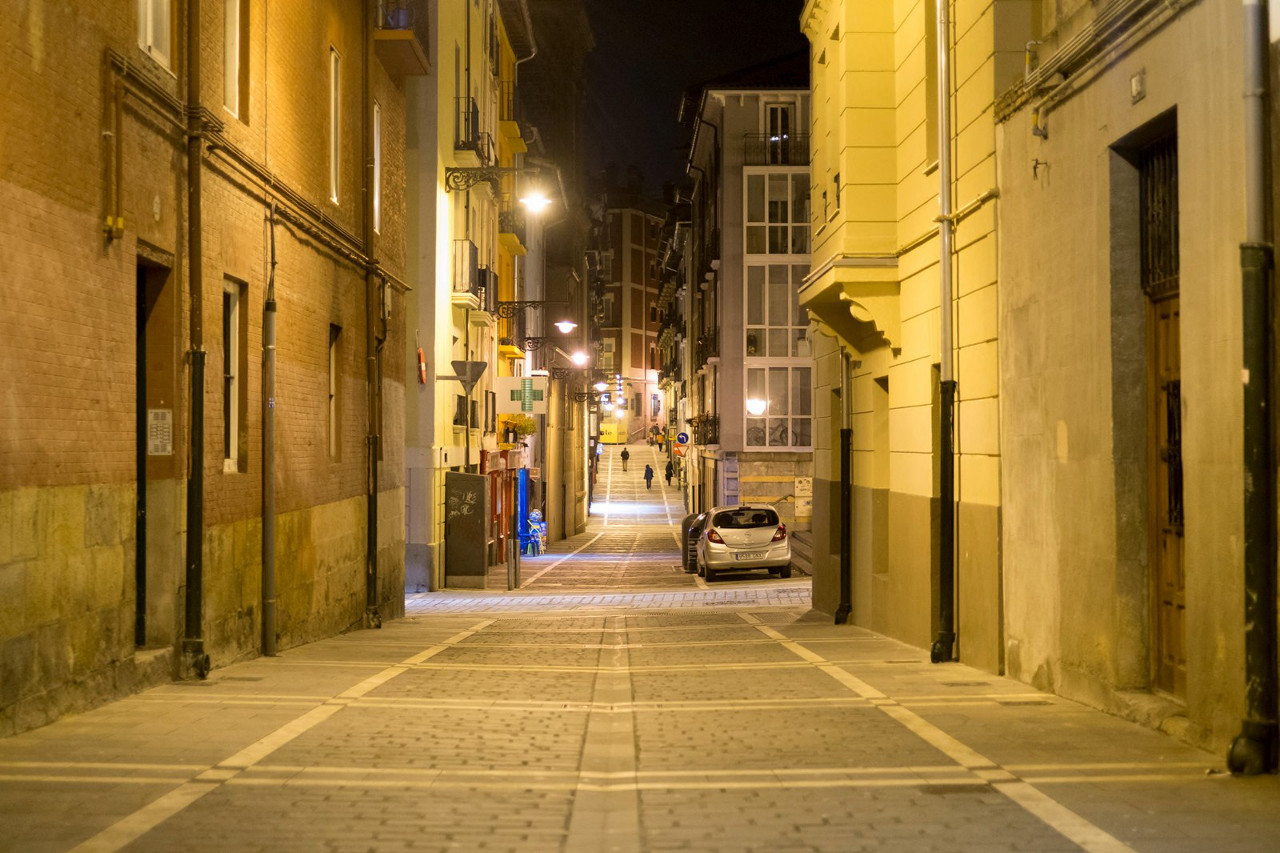
I had the opportunity at the end of January to travel to Spain for a series of meetings and site visits related to a wind project I am working on. The business parts of the trip went well but are not terribly interesting to write about. But it wasn’t all business, and I did get walking tours of central Madrid and Pamplona while we were there.
I admit that I was fairly nervous before traveling. I hadn’t been to Europe in years and years, and I was worried about the language barrier and having trouble getting around. I should have known better. There certainly is a language barrier in Spain, but it’s more of a low fence than a wall. People in general are very friendly and willing to help out. I didn’t get any sense of the “stupid American should have learned Spanish” feeling I dreaded.
I wish I did know Spanish, because it would have made things more fun, but at least I didn’t feel like an outcast.
So most of my worries were unfounded, and what the trip really taught me is that I should travel more. Worries about language and finding my way around are excuses rather than reasons. Spain is a modern Western country and it generally makes sense. I’m fairly smart and can find my way around. People are mostly friendly and helpful. Just go and you can work through it. I sometimes get worked up about travel even when I’m just going to Canada (what if they speak French?) and it is never an actual problem.
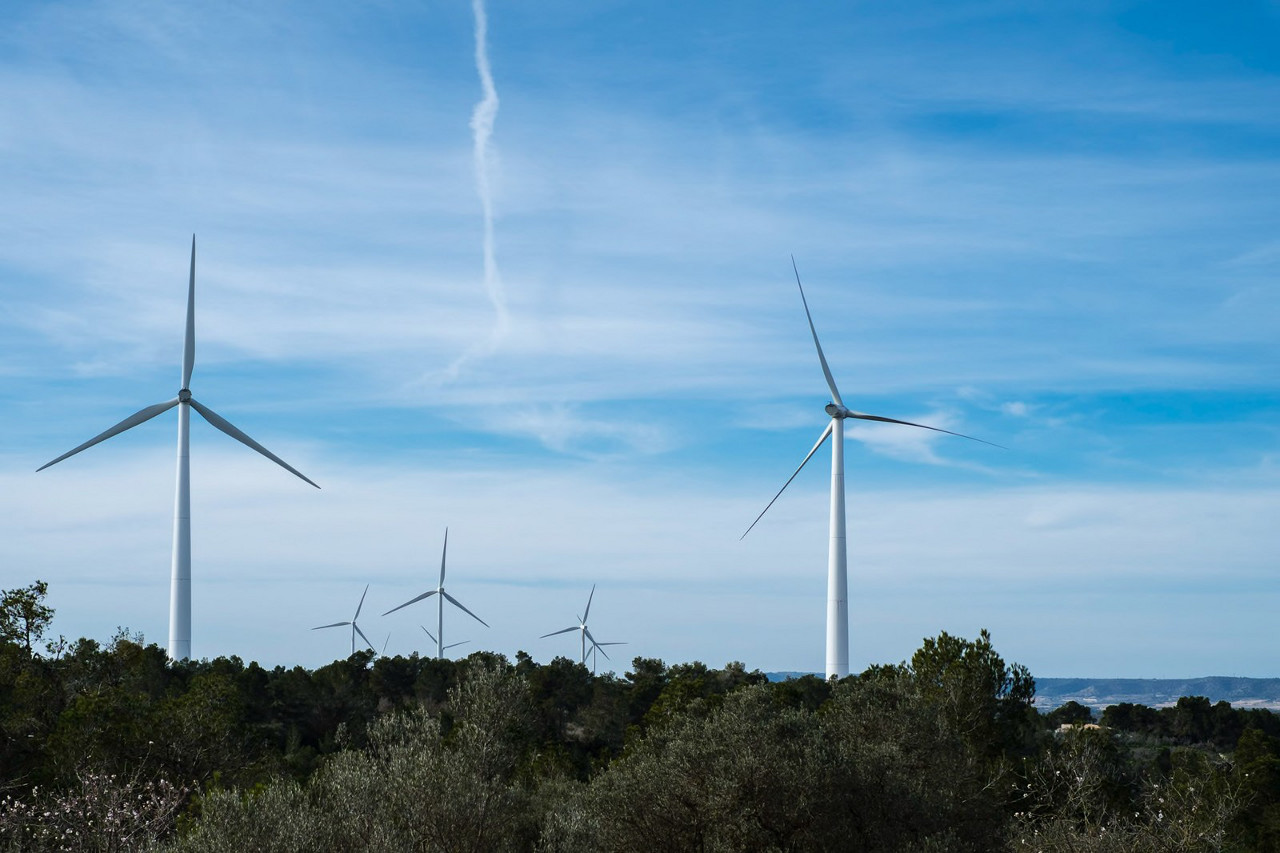
We spent most of our time between Madrid and Pamplona, with a brief visit to Lleida to see a wind project near Almatret. Work kept us busy, with long days, so I didn’t get nearly as much time as I would have liked to explore.
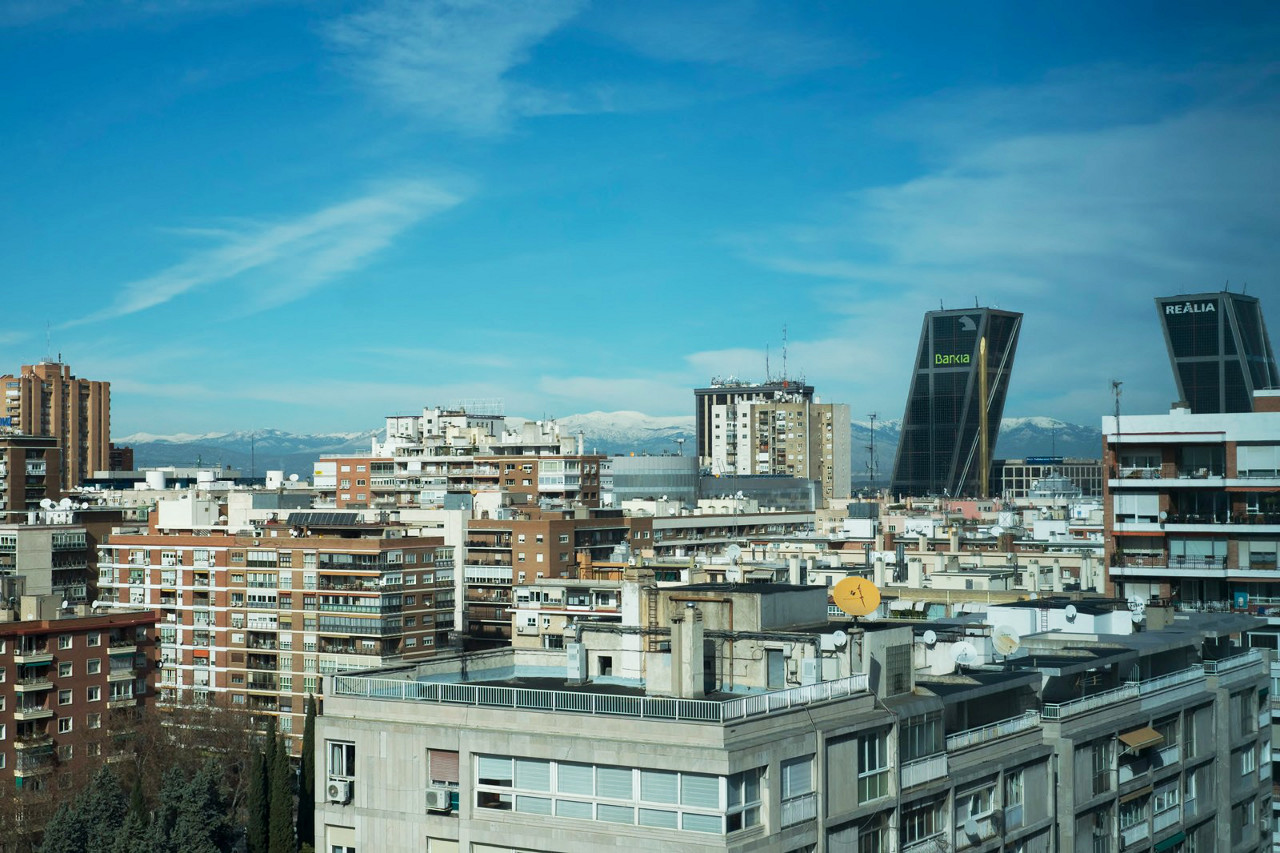
The first day was in Madrid for a few meetings. I had a decent view from my hotel room.
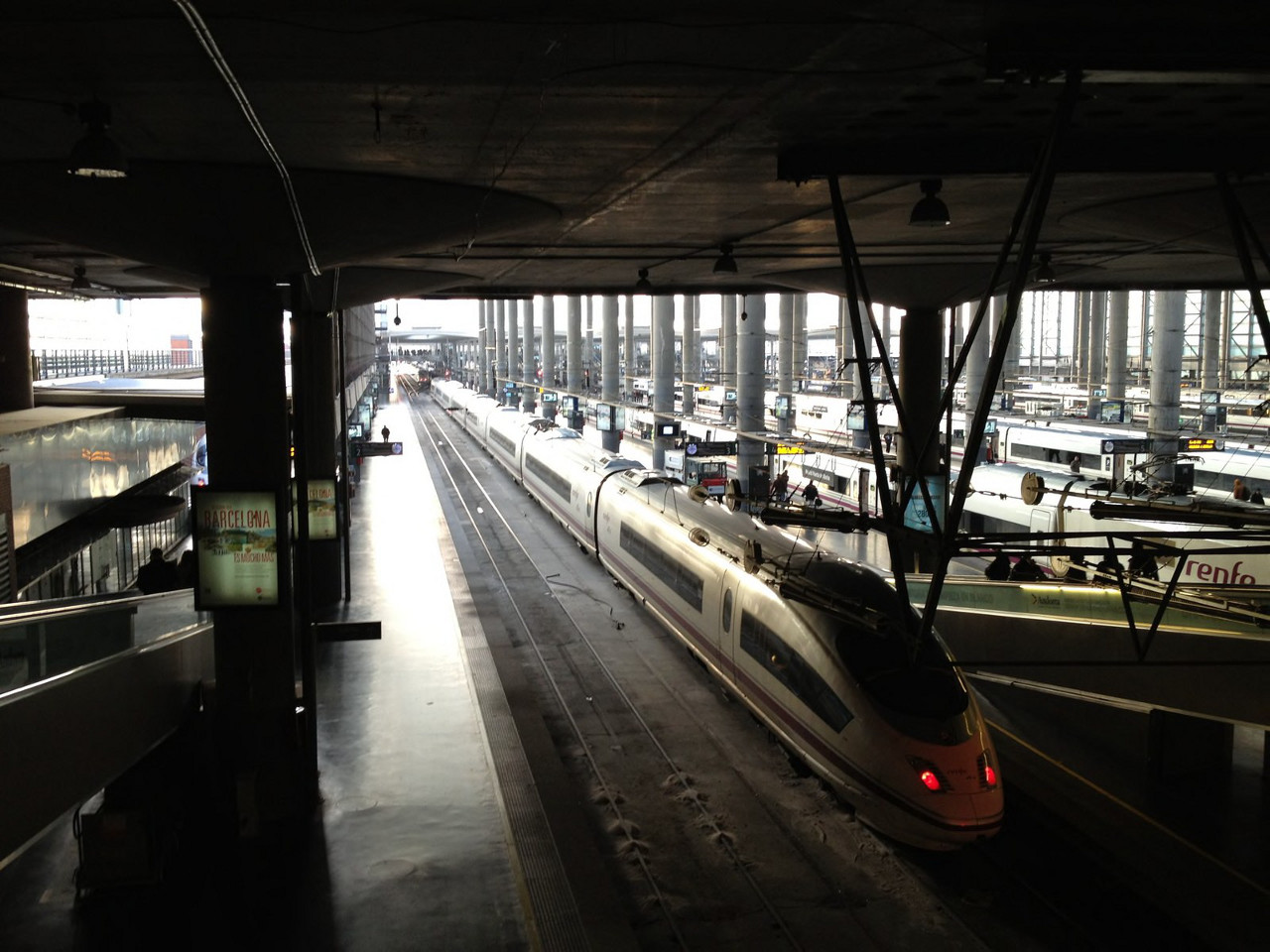
We rode the Renfe AVE high speed train from Madrid to Lleida. It was very nice, riding at 300 km/hr (185 mph) across the countryside.
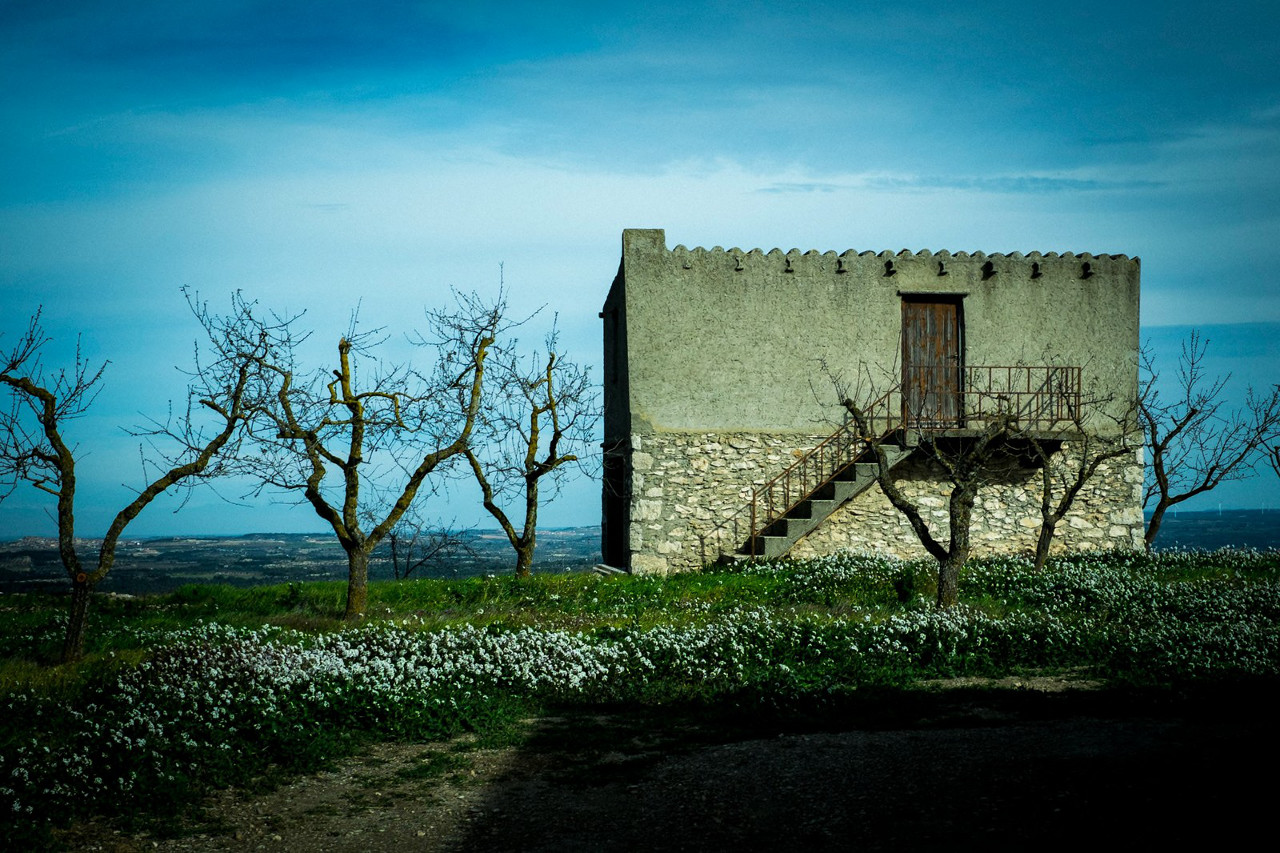
When we got to Lleida we drove up towards Almatret to visit a relatively new wind farm.
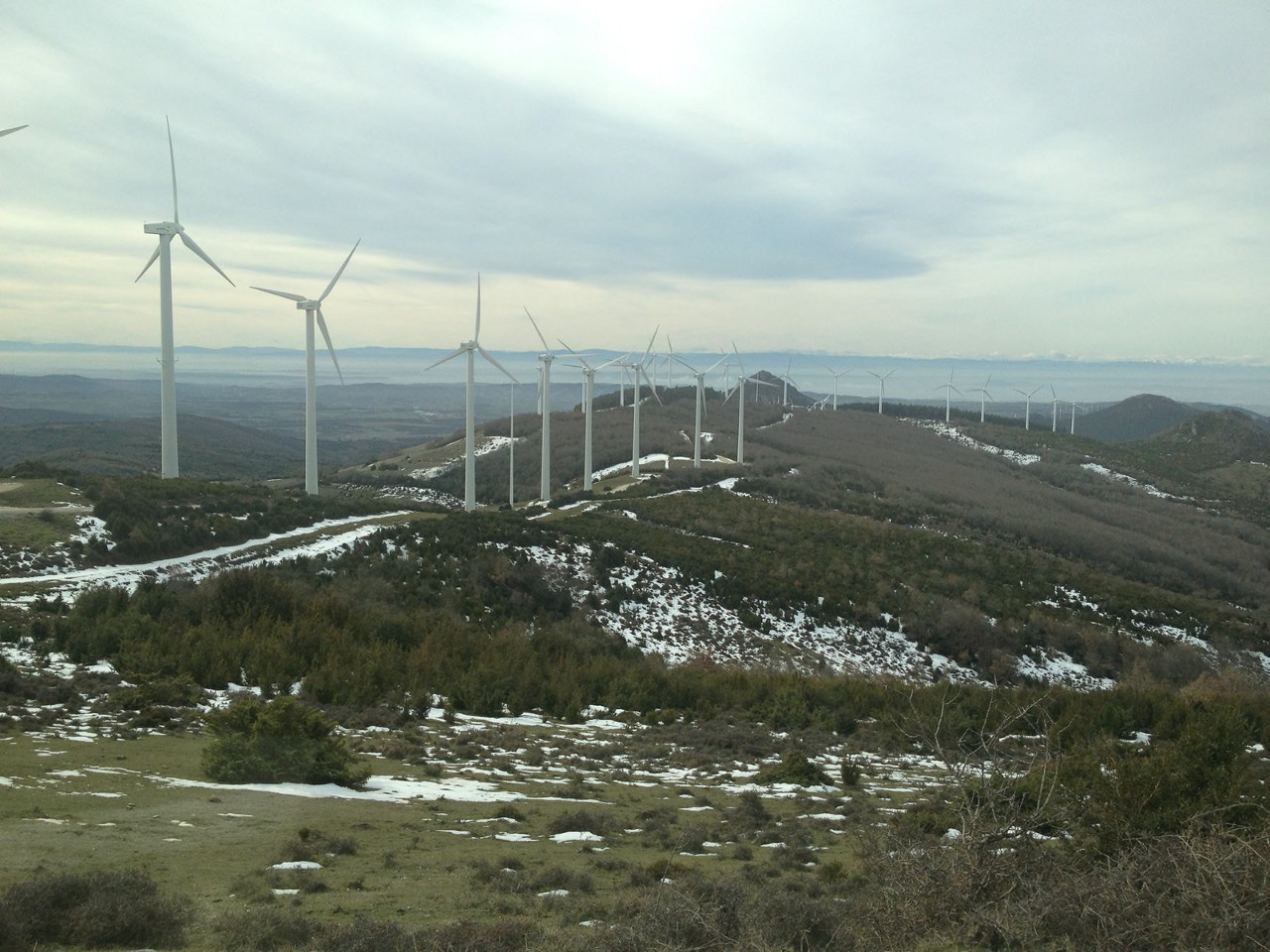
After that we headed to Pamplona for a couple days of meetings, some factory visits, and a visit to another wind farm.
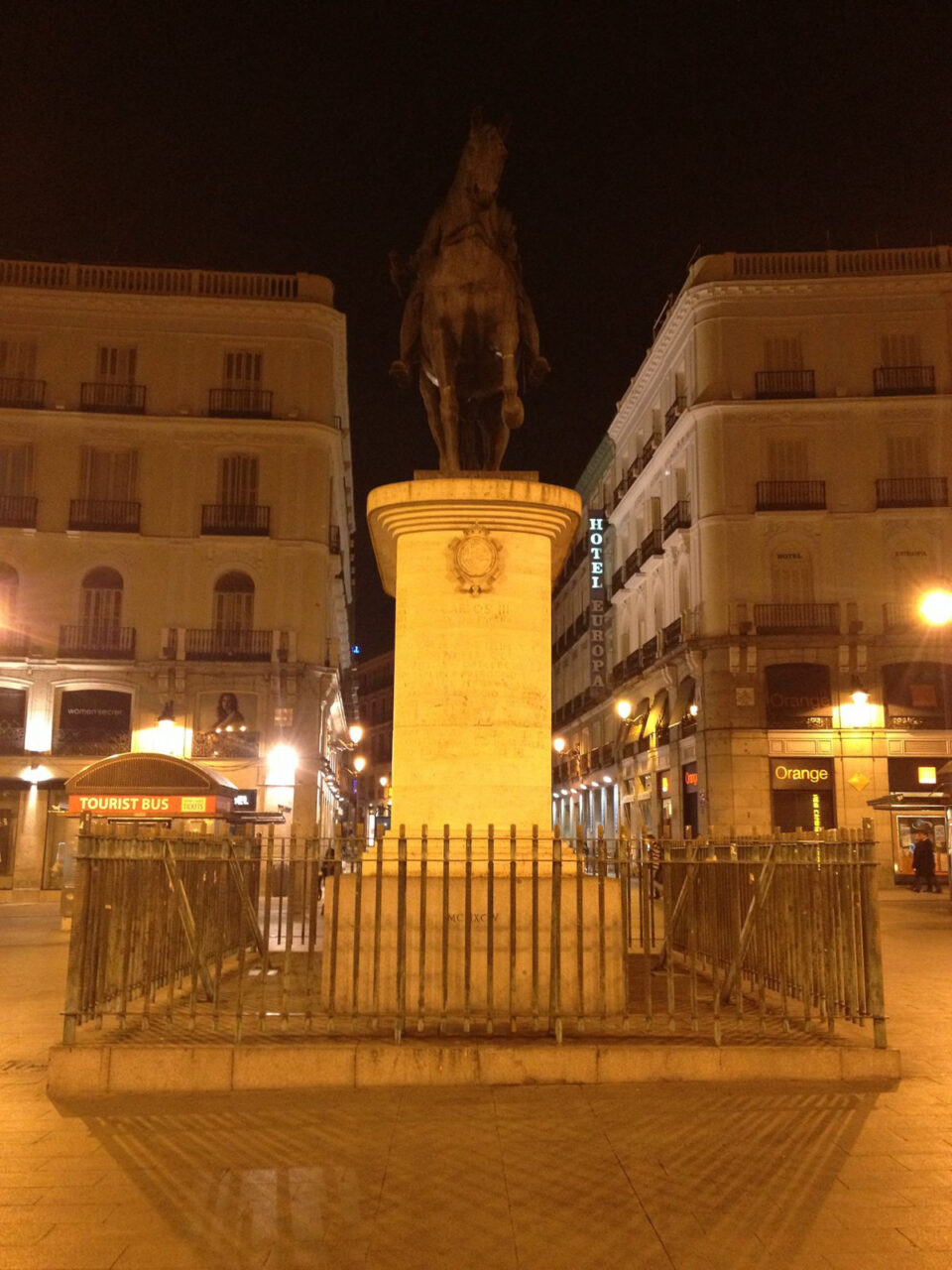
We flew back to Madrid for one last day of meetings before heading back to the US. We got a walking tour of downtown Madrid on our last night in town.
I got enough that I very much want to go back, and travel around on my own time with a camera and tripod and days to get lost and have no set schedule. A proper vacation. Northern Spain has some fantastic views, most of which I didn’t have a chance to photograph.
I decided to start running late last November. I don’t think I had any specific reason, but a few weeks before I started I played a pickup football game with my cousins and realized just how far out of shape I was; it was far more than just being overweight. I could hardly breathe partway through the game and the next day I was still and sore all over. I had a great time playing but it would have been much better if I could run.
I picked up an inexpensive pair of shoes and started looking at the common couch to 5k training programs on the internet. I chose a fairly simple one with straightforward progression and an iPhone app. The app is literally just a set of timers and voice prompts, but it is enough. I record each run using RunKeeper to better track my progress.
When I started a run was a minute of run time followed by a minute and a half of recovery time. And it was hard. Really, really hard.
Although I cycle a lot it’s clear that cycling and running are very different activities. Weight does matter on the bike, but realistically the bike carries most of your weight and you just have to supply the momentum. I could ride 40 miles in any given day but couldn’t run for 5 minutes.
But in a couple of weeks I had progressed from 90 seconds to 3 minutes of running at a time, then 5, then 6, 7, 8, and 10. By 2 and a half months I was stringing together a 10 minute run with a 15 minute run with only a few minutes to recover in between.
And today I got rid of the recovery time in the middle and did 25 minutes nonstop. 2.2 miles at 11:30/mile.
I know that probably won’t impress any of my running friends, but less than 3 months ago I couldn’t go 2 minutes at a stretch. At the new year 4 or 5 minutes was nearly impossible. Now a 5k (3.1 miles) is definitely in reach. I finished tonight’s run and easily had a few more minutes in me.
I’ll give it a few more weeks of increasing the time until I can do a 5k nonstop. Based on my average running pace on RunKeeper that will take about 35 — 40 minutes on nonstop running. And I think I’ll get there fairly soon.
I honestly didn’t think I would improve this fast. Some days, even earlier this week, have been brutally hard and left me unable to meet my goal. But the good days are enough and I’ve kept at it.
In fact that’s the most important thing to me. I have stuck with this so far. I wasn’t sure I would when I started, which is why I haven’t written about it until now. My sister Annie, a dedicated and very fast runner, was good motivation, especially on the hard days.
And except for those times when I’m out of town I’ve been able I go out 3 times a week every week, and every week is better than the one before.
Once I hit a 5k, at any pace, I’m going to work to increase my speed and lower that to a 5k at a 10 minute pace. From there I don’t know where I want to go yet, whether a 10k or trying to get my mile pace down. I might work on pace first, and then work on a 10k after that.
Do me a favor and keep an eye on my RunKeeper page, and nag me if I start to slack. I’ve done well so far but support never hurts.
I took a long and sorely needed break for Christmas at the end of the year. I drove I70 across Kansas to the Kansas City area the week before Christmas and stopped for two nights at my aunt and uncle’s in the charming little town of Weston, Missouri. The big snowstorm happened the night before I drove, and although I had no trouble getting to KC, Weston had a few inches of bright white snow. The last 15 miles on the way up to the town were the slowest and slipperiest.
Weston and Kansas City
I got to stop by and see my cousin Greg’s family the first night. His little girl is 3 now, and his infant son, who never seems to stop smiling, is growing quickly. When I got to their house the first thing Posy wanted to do was show me “around the house” which meant following her to her play room and playing with her toys.
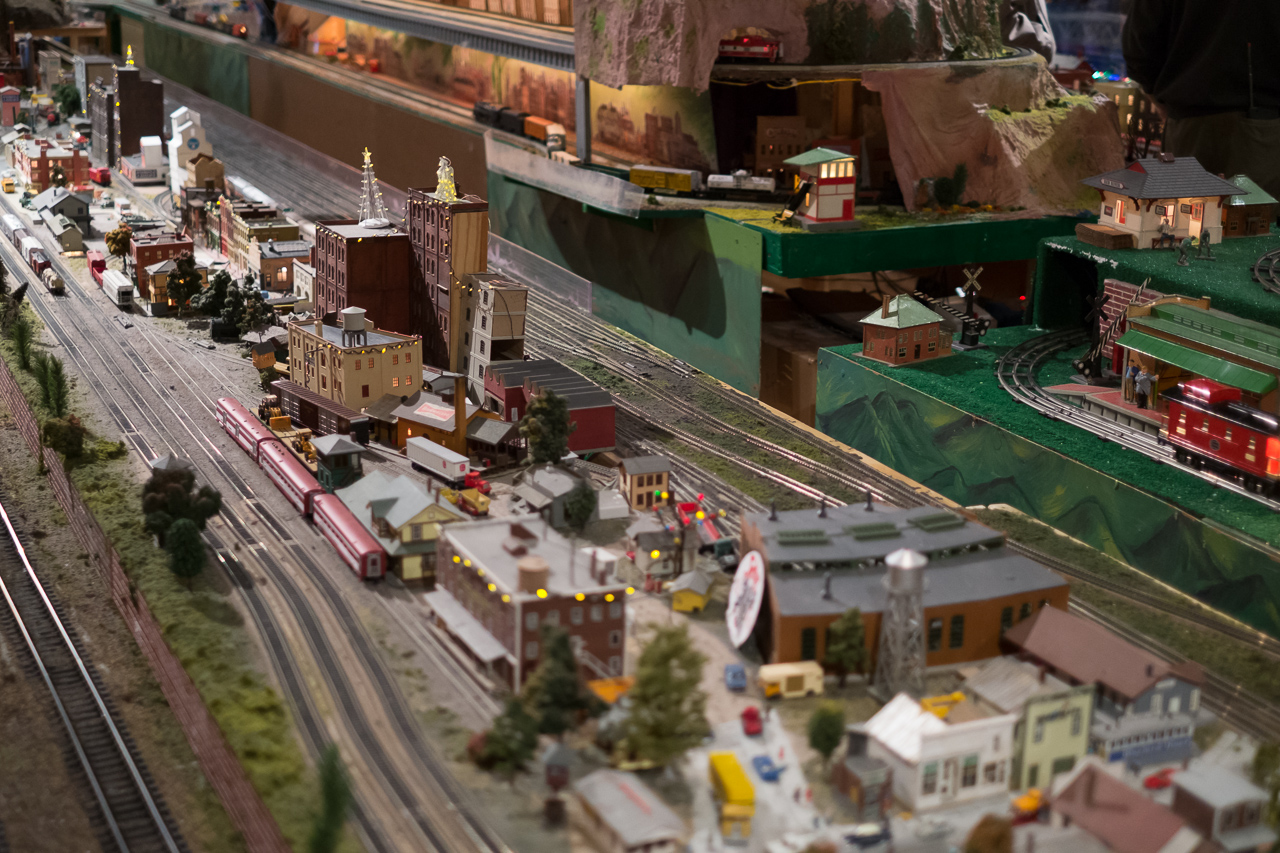
On the second day I walked around town in the snow for a while, then headed down to Kansas City. I visited some old haunts and did some reminiscing. Lunch at Grinder’s, an hour or two at Union Station and Liberty Memorial. Touring the model train display at the station. Coffee and photo review at the Broadway Cafe. The train display is always fun, and I took a mess of photos.
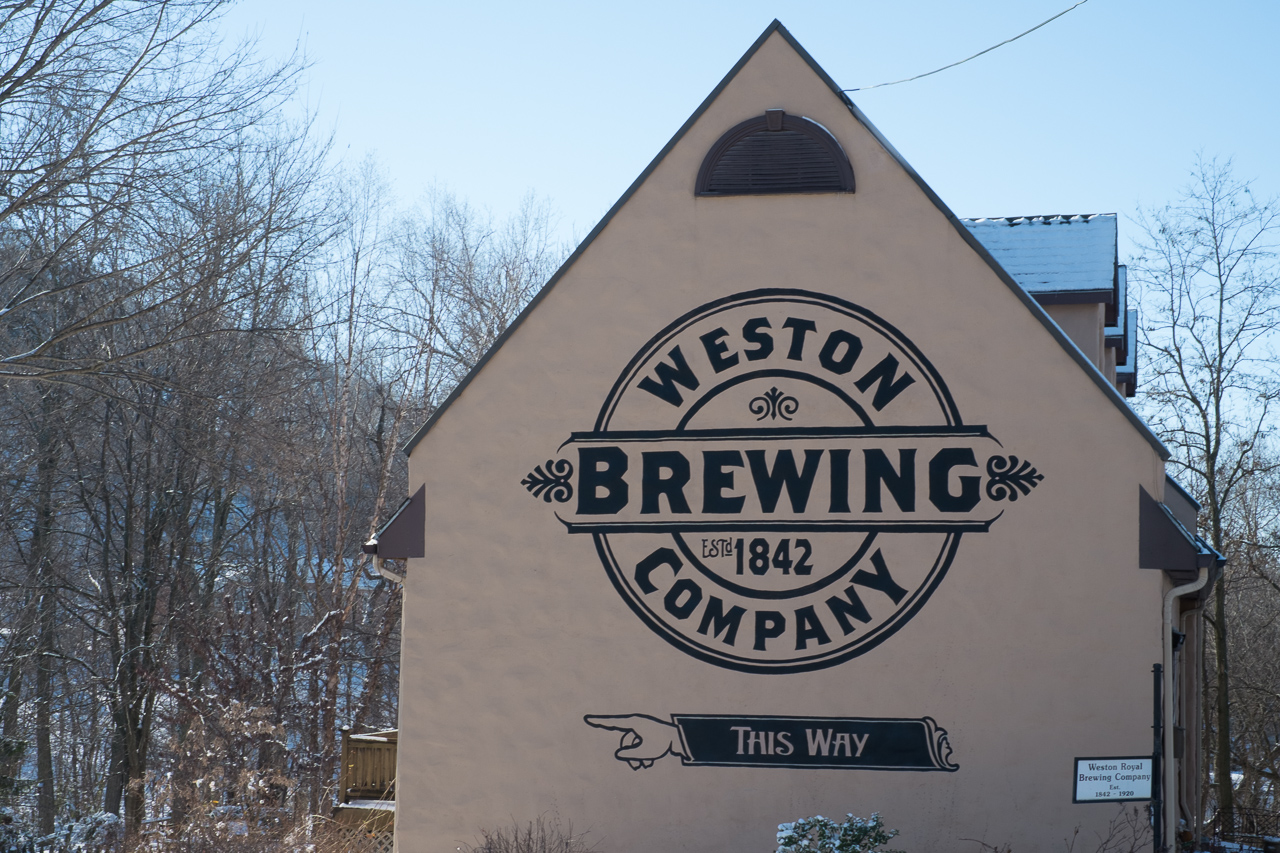
Saturday was my last morning before heading to Iowa, and I met Greg at his house and we walked down to the brewery. We got a short informal tour and a beer together before I had to hit the road.
Christmas in Iowa
After a couple of days the highways in Iowa were in better shape (initially they were very bad, and I would have had to wait to go to Iowa) and I drove north to Ames. I made it safely home and began a nearly two-week break there. There’s no need to go into detail on everything, but we got the whole family together for Christmas, and did our traditional gift exchange. I got several books I’m looking forward to read, and my older sister got me one of my favorite prints that I need to frame. My little sister got me the Bike Snob‘s first book. She didn’t even know that I was a huge Bike Snob fan, just thought I would like it.
My parents got me a number of things, the best of which may have been the bright red stand mixer. I’ve made bread twice since I got home, and I’ll make pizza soon (I need a stone, first). Until the novelty wears off I’m going to end up eating a lot of bread.
I got a number of other things, including a second 5 gallon fermenter. Now I can have 2 or 3 batches of beer going at once. I have a 6 pack of Bell’s Two Hearted and I may try to harvest the yeast and brew a version of that fantastic beer myself. The yeast harvest, if successful, will probably be its own post.
Polar BBQ
Andy can correct me here, but I believe this was our third polar BBQ ever. The first was held in Brookside Park when we were still in college, and was freezing cold. We drank beer and hung around a shelter late at night in the winter, and felt manly.
The second was held a few years later during Christmas break, at the Janke’s house in Ames. We grilled steaks outside and drank fancy beer, but we essentially punted on the polar aspect by spending most of our time inside.
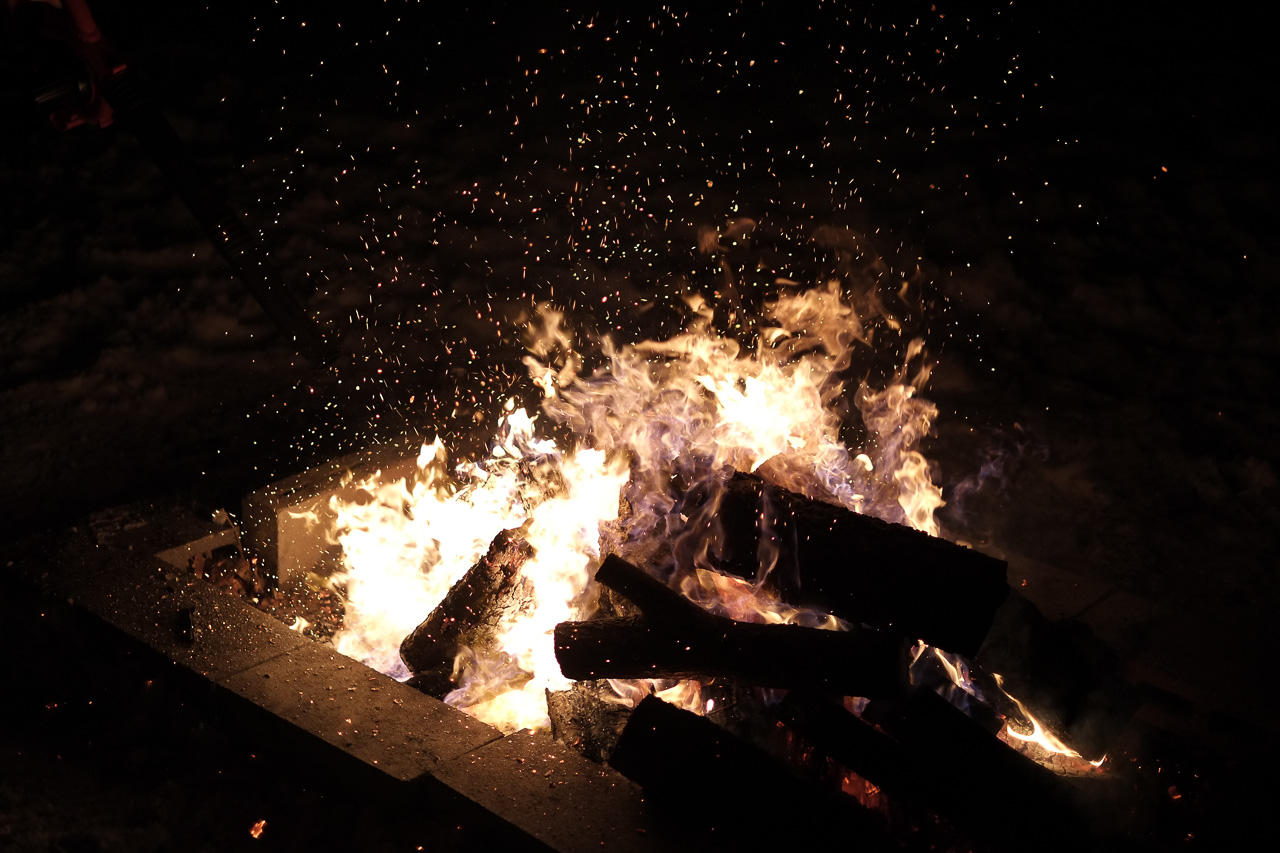
This third time, we did it properly. We held it at Andy’s house in Des Moines, and the whole town was still deeply snowed in and peacefully quiet. When Andy and I started, it was gently snowing big flakes. Although it was biting cold, we built a large fire in his fire pit, and this was the key to a successful polar BBQ. We spent hours outside, pausing to eat delicious pulled pork and chicken drumsticks indoors, before returning to the fire for the rest of the night. We burned a good chunk of the old wet wood in Andy’s wood pile.
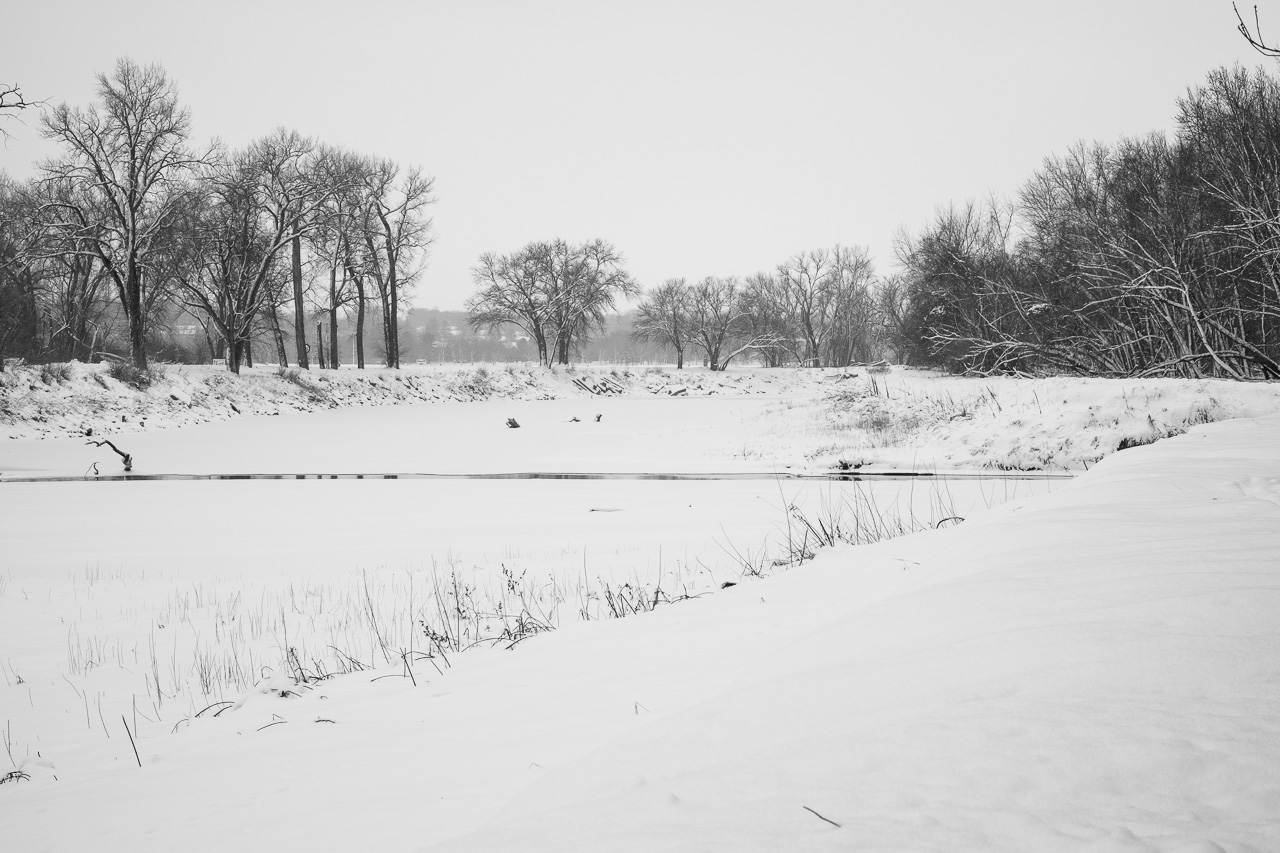
The next morning I went for a walk alone on the bike path down from Andy’s house, by the river. It was gently snowing again, and very peaceful.
New Year’s
I drove to Des Moines again a few nights later for a small and fun New Year’s celebration. We met at Erik’s house, and he made a number of really awesome pizzas. I’m not sure which was my favorite, but they were all good. We drank a few beers and some Cava, and rang in the new year like the dorks we are by beating the 4 player Super Mario for the Wii.
Amy and Lindsey joined us initially, but they both went to bed early, and it was just a boy’s night in the end.
Everything else
I wasn’t terribly exciting in general, but we managed to fit in a visit to CHC, which is still fantastic. Ben and I also went to West Street Deli one day, and drove over to Boone on Jess’s recommendation to try out the Boone Valley Brewing Company. I went over to the big house in Nevada a couple times, and met my dad for lunch a couple of times as well. And although it was terribly cold the whole time, the trip was refreshing and the break did me good.
I brewed beer twice in the past few months. I wanted beers to share with family and friends this Christmas. One is meant to be a warming and flavorful high gravity beer and the other a tasty session beer. I settled on brewing a robust porter for the former, and an ESB[1] for the latter.
These were the first two original recipes I developed. Previously I was brewing either extract-based kits or all-grain recipes developed by others. I developed these recipes myself based on the BJCP guidelines and a few published recipes for style-leading examples I knew.
The ESB is based on a Northern Brewer recipe, notes on ESBs in general, and some recipes people shared on forums. It uses the Fuller’s yeast strain. The porter is based on Dry Dock‘s Urca Vanilla porter (without the vanilla) and a different English yeast strain. The porter has some Belgian Special B malt and some chocolate malt (for raisin and chocolate flavors, respectively), which contribute to a high finishing gravity. This should be perceived as a thicker, more fully bodied taste. I’m actually a little outside the guidelines on finishing gravity but I decided that’s OK.
I bottled these beers over the Thanksgiving weekend. The process went smoothly, but as always it was frustrating and somewhat messy. There may be ways around this but I haven’t found them. Kegging seems obvious but that requires more space than I have right now.
I took my final gravity readings and calculated the apparent alcohol and nutrition content of each beer. I also tasted the samples, which even when warm and flat give some hint of the final beer.
ESB
Style
Extra Special Bitter
BJCP Reference
Calories (12 oz)
170
N/A
IBUs (bitterness)
44
30 — 50
Color (SRM)
8.3 (pale brown)
6 — 18
ABV
5.5%
4.6% — 6.2%
OG
1.052
1.048 — 1.060
FG
1.010
1.010 — 1.016
Robust Porter
Style
Robust Porter
BJCP Reference
Calories (12 oz)
220
N/A
IBUs (bitterness)
49
25 — 50
Color (SRM)
27 (deep brown)
22 — 35
ABV
6.4%
4.8% — 6.5%
OG
1.067
1.048 — 1.065
FG
1.018
1.012 — 1.016
The ESB was very clean, with a strong bitter flavor but not a lot of hop aroma. My last hop additions (at flameout) should impart some aroma but I’ll have to wait until the bottles carbonate and I try one to know for sure. Otherwise since it is an ESB it should be bitter in flavor but have less of a hoppy nose than an IPA. Once this carbonates I think it will be if not very good at least a pleasant session beer.
The porter on the other hand was full flavored, and although it has a decent amount of bitterness in the recipe the malt flavors show through more strongly. The chocolate malt is quite noticable. The relatively high alcohol level is also noticable. The beer at bottling time still had very minor yeasty hints in the smell, but I’ve had this before and they settled out with carbonation and chilling. Hopefully that will happen here as well. I have a feeling that the porter will taste good, but may not reach peak flavor until a few months of bottle conditioning, as even with over a month in the secondary fermenter it still had a bit of an edge. Again, we’ll see. I won’t know until early December how the final result will be, and I didn’t want to wait to post this.
I’m really looking forward to sharing these beers with my friends and family next month. And now it’s time to develop and brew a new recipe.
— Steve
Extra Special Bitter, a stronger version of an english Premium/Best Bitter↩︎
I finally decided which of the new breed of mirrorless cameras to buy. I’ve been looking for almost a year, and since April I’ve rented and tested four of the most interesting mirrorless cameras on the market: the Sony NEX-7, Fujifilm X100, Fujifilm X-Pro1, and Olympus OM-D E-M5. The choice was difficult but I finally settled on the X-Pro1’s recently announced little brother, the X-E1, which shares the sensor, lenses, and processor of the larger camera.
I came to this decision after a couple of nights spent taking a hard look at the photographs from each of these cameras. While I liked the results from the Sony and Olympus cameras a lot, the results I got from the Fuji X-Pro1 were the best to my eye. It doesn’t hurt that Fuji has the best lens roadmap of the bunch.
But the Fuji camera also has a crippling flaw. Although Adobe Lightroom can technically read raw frames from the X-Pro1, it does a terrible job.
This wasn’t immediately apparent when I started working on photos from the X-Pro1. They looked excellent, with great color and image quality. But after a trip up Mount Evans that included a lot of rocks and foliage with fine detail and small patterns, I noticed a very strange look to the images at full pixel resolution. The best words I could come up with were “painted” and “smeary”.
This can be clearly seen in the full-size crop of a recent shot. The rocks look smooth and angular, like Bob Ross painted them with careful strokes of a knife; not at all real at this scale. At smaller sizes you can’t see this, but for large viewing or printing it is very apparent.
The JPEGs out of the camera didn’t exhibit this. They show some smoothing but nothing like what Adobe is producing. It is not some inherent problem with the camera or the sensor layout.
Since I mostly shoot raw, and rely on Lightroom for my photo management and raw processing, this is a real problem.
It starts with the unusual layout of the Fuji’s sensor. The X-Pro1 and X-E1 don’t use a simple Bayer pattern sensorwhich almost every single digital camera on the market uses. Instead, Fuji went with a highly modified sensor layout they called X-Trans. The reasoning and concept behind this make sense on the surface, but the end result of this unusual array is that most raw processors, including Adobe’s, suck at demosaicing the data. If they even support it at all. The well tested Bayer algorithms don’t work, and developing new ones for this sensor is apparently a hard problem involving more difficult math.
Several raw processors have even stated they won’t support the camera at all, or that it will be hard to do so and they have no timeline. I understand that they want to support more the common cameras first, but if selling raw processors is your business then it is also your business to support unusual cameras in addition to the common ones.
Adobe, probably the leader in the raw photo software world with Adobe Camera Raw and Adobe Lightroom, does support the X-Pro1 (and will presumably support the X-E1), but it does not do so well.
I decided to buy the X-E1 anyways, but this problem bothered me. Was this going to stop me from being able to get the most out of this camera? Should I give up on the camera I wanted because the software had trouble with the hardware? The JPEGs are so good that in the short-term I can use them, no problem. But there are some photographs, like the example I’m using here, that really need the extra data in the raw file to get the best final result. In weirdly lit cases like this I need all the extra headroom I can get.
Lightroom did a fine job with the scene and with recovering the blown highlights (not shown in these crops), but it did a poor job at resolving fine detail. What about Fuji’s processor?
Fuji supplies a raw file converter with an engine based on SilkyPix, a japanese raw processing studio that makes very little sense to me. The translations are really bad, and the interface is confusing. But Fuji worked with SilkyPix up to the release of the X-Pro1 so that it would be able to process the raw files, and is generally considered the reference raw processor for this camera.
It’s much more difficult to use than Lightroom. I wouldn’t want this converter to be my permanent solution, but it works. I processed the same photo using the Fuji converter and tried to duplicate most of the processing settings from my original work to get a similar look. I didn’t spend much time matching them perfectly, but the comparison is telling. Adobe’s processor (shown above) is failing to retain fine detail and introducing false colors.
The results are easier to see at higher magnifications. Here are 2x crops from Lightroom, SilkyPix, and out of the camera, in that order.
So, as discussed, Lightroom really struggles here. The result is smooth but it definitely does not look realistic. The SilkyPix conversion on the other hand looks like actual rocks. It also clearly resolves more detail from the same input data. But the software is a pain to use.
This gives me hope though, because turning a raw file into an image is basically a math problem. If one developer can solve that problem then so can another. But it does mean that right now Lightroom is basically useless for the camera I just ordered. And that’s really too bad.
For now the plan is to keep using Lightroom, but only for basic photo management. I’ll shoot raw+jpeg, and use the jpegs for most things. I’ll process individual raw files in the SilkyPix converter when I need to get the most out of the data, but otherwise mostly just hold onto the raw files in the hope of some future Lightroom update where they fix the processing problem.
It’s definitely not ideal, and I wonder if I’m just getting myself into trouble by not choosing a more conventional camera. But find me a more conventional camera this size, with lenses this good, actual traditional controls, and image quality this high for a price like this[1].
Adobe, I need your help. Bribe Fuji if you have to. Charge me for an update. Buy SilkyPix and steal their processing engine. Just get this working.
— Steve
I did get a picture of the same rock face from a similar position with my older Olympus E-410 and an equivalent focal length lens. I was a little farther away, but it definitely resolves less detail than the newer Fuji, and has more noise.↩︎
There is a lot of brewery action happening here in Denver this weekend. The dunkelweizen I bottled 2 weeks ago is ready to drink, and appears to have turned out very well. Good carbonation and great head retention, with the right color and a very nice flavor. I’m quite happy with my first wheat beer.
Meanwhile, I racked the robust porter I brewed 3 weeks ago to its secondary fermenter, and I’m preparing to brew an all-grain ESB tomorrow.
The ESB is a recipe I developed based on the BJCP style guidelines and suggestions from Ray Daniels’s Designing Great Beers. I’m again going with a 50/50 mix of 2-row pale malt and Maris Otter, with about 7% of 40L caramel malt and 5% Munich malt for color.
I made the yeast starter this afternoon; this is the first time I get to use my stir plate from Stir Starters